SGI Logo
About | Careers | Salvage | Contact
SGI Logo |
Individuals
Businesses
Partners
Online services
Registration & insurance
Driver licensing
Penalties & suspensions
Claims
Medical conditions
Road safety
Saskatchewan Driver's Handbook / Basic information and rules of the road / Headlights
Driver's Handbook
  • 1 - Introduction
  • 2 - Saskatchewan driver's licence program
    • 2.1 - Driver's licence
    • 2.2 - Vehicle registration
    • 2.3 - Graduated Driver's Licensing
    • 2.4 - Change of name or address
    • 2.5 - Classified licence system
    • 2.6 - Medical requirements
    • 2.7 - Mandatory driver education
    • 2.8 - Preparing for your road test
    • 2.9 - Before the examination
    • 2.10 - Your test
  • 3 - Basic information and rules of the road
    • 3.1 - Speed
    • 3.2 - Care and attention
    • 3.3 - Stopping and parking
    • 3.4 - Sharing the road
    • 3.5 - The concept of gates
    • 3.6 - Blind spots
    • 3.7 - Directional dividing lines
    • 3.8 - Traffic lanes
    • 3.9 - Lane position
    • 3.10 - Lane selection
    • 3.11 - Signalling
    • 3.12 - Changing lanes
    • 3.13 - Passing
    • 3.14 - Bus lanes and bicycle lanes
    • 3.15 - Turning
    • 3.16 - Centre turning lanes
    • 3.17 - Right of way
    • 3.18 - Stopping positions
    • 3.19 - Traffic circles
    • 3.20 - Highways
    • 3.21 - Pedestrians
    • 3.22 - Crossing urban streets
    • 3.23 - Wheelchairs and medical scooters
    • 3.24 - Motorcycles
    • 3.25 - Medians
    • 3.26 - Parking lots
    • 3.27 - Headlights
    • 3.28 - Night driving and low visibility
    • 3.29 - Choosing the right speed
    • 3.30 - When to dim your headlights
    • 3.31 - Rules related to vehicles
  • 4 - Traffic signs and signals
    • 4.1 - Traffic signs
    • 4.2 - Six basic sign shapes every driver must know
    • 4.3 - Standard sign colours
    • 4.4 - Regulatory signs
    • 4.5 - Regulatory parking signs
    • 4.6 - Regulatory pedestrian crossing signs
    • 4.7 - Regulatory lane designation signs
    • 4.8 - Regulatory turn control signs
    • 4.9 - Warning signs
    • 4.10 - Construction signs
    • 4.11 - Railway crossings
    • 4.12 - Crossroad delineators
    • 4.13 - Guide signs
    • 4.14 - Information signs
    • 4.15 - Traffic signals
  • 5 - Basic driving skills
    • 5.1 - Hazards
    • 5.2. - The IPDE method of driving
    • 5.3 - Time - The key to judgement
    • 5.4 - Eye use
    • 5.5 - Before you drive
    • 5.6 - Steering
    • 5.7 - Accelerating
    • 5.8 - Standard (manual) transmission vehicles
    • 5.9 - Gears
    • 5.10 - Low speed skills
  • 6 - Advanced driving skills
    • 6.1 - Parking
    • 6.2 - Turning
    • 6.3 - Highway driving
    • 6.4 - Passing
    • 6.5 - Curves and corners
    • 6.6 - Driving in mountains
    • 6.7 - Grid, municipal and resource access roads
    • 6.8 - Winter driving
    • 6.9 - Braking
    • 6.10 - Emergency driving
    • 6.11 - Understanding collisions
    • 6.12 - What to do if you are in a collision
    • 6.13 - Impairing factors
  • 7 - Complying with the law when driving
    • 7.1 - The Traffic Safety Act
    • 7.2 - The Criminal Code of Canada
    • 7.3 - Traffic tickets
    • 7.4 - Driver Improvement Program
    • 7.5 - Save Driver Recognition
  • Fuel-efficient driving techniques
3

Basic information and rules of the road

3.27 Headlights

Tools
Font + Font - Reset Print Translate Bookmark Facebook Twitter Email LinkedIn Google

It is advisable to have your lights on at all times because studies show that vehicles driven with lights on at all times are much less likely to be involved in collisions than those operated with their lights on at night only.

The law requires the use of headlights from half an hour after sunset until half an hour before sunrise, and at any time when visibility is poor.

Note: Some vehicles do not have tail lamps on when daytime running lights are being used.

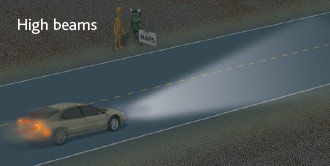
When meeting another vehicle, you must dim your headlights at least 200 m (650 ft.) in advance of oncoming vehicles and keep them dimmed until the vehicle has passed.

Also, turn off any spotlamps at least 500 m (1,640 ft.) in advance of an oncoming vehicle and keep them turned off until the vehicle has passed.

You are not required to dim your headlights for oncoming traffic if you are driving on a divided highway where the distance between the roadways is 22 m (70 ft.) or more (the distance is measured from left shoulder marking to left shoulder marking in each direction of travel).

You must keep your headlights on low beam within 100 m (330 ft.) and keep any spotlamps or auxiliary driving lights turned off within 500 m (1,640 ft.) when you are following another vehicle, or when you are being passed.

Low beams
Low beams
Low beams
Previous page Next page
Disclaimer
Google Translate is a third-party tool, and is not owned or administered by SGI. SGI is not responsible for any errors or omissions as a result of the translation. In case of a difference in interpretation between the translated version and the laws and regulations governing Saskatchewan drivers and vehicles, the laws and regulations prevail. See Terms of use.
Rev: 2012
Visit SGI on:
SGI Facebook
SGI Twitter
SGI YouTube
SGI Flickr
SGI LinkedIn
SGI RSS News Feed
Mobile Apps
Privacy | Terms of use | SGI CANADA | Help / FAQs
Saskatchewan driver's licensing and vehicle registration
© SGI. All rights reserved.