All vehicles must be properly registered according to purpose and must display the appropriate licence plate.
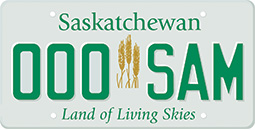
Licence plates must be securely attached and clearly visible. That means plates must not be obstructed in a way that prevents them from being read or accurately photographed by any enforcement system.
The number or identity of the licence plate must not be altered or changed in any way.
If you're a new resident you have up to 90 days to register your vehicle in Saskatchewan. Basic insurance coverage is required.
A non-resident (someone who does not own, rent or lease a residence in Saskatchewan and, if required, does not pay Saskatchewan income tax) may drive in Saskatchewan indefinitely providing your out-of-province or out-of-country driver's licence remains valid.
How auto insurance works in Saskatchewan
Saskatchewan auto insurance comes in two parts:
- Basic minimum coverage - Is required by law and is purchased at the same time you pay for your licence plates and vehicle registration. This coverage is compulsory and is provided by SGI.
- Additional coverage - Sometimes referred to as extended auto insurance, a package policy, or an Auto Pak, additional coverage is tailored to your needs and is provided on a seperate auto insurance policy. This important protection may be purchased from the insurance company, broker or agent of your choice.
Licence plate insurance coverage
Your licence plate basic insurance coverage in three areas:
- Collision and comprehensive - Coverate for damage to your vehicle, subject to a deductible.
- Personal injury - Benefits for personal injury resulting from a vehicle collision.
- Liability - Insurance for damage your vehicle causes to another vehicle or property, or injury to others.
Collision and comprehensive is also known as physical damage coverage. It pays for damage to your vehicle due to a collision or other occurrence such as hail, fire or theft1.
Personal injury benefits provide Saskatchewan residents with injury and death benefits if they are injured or killed in an automobile collision anywhere in Canada or the United States. All Saskatchewan residents have a choice between two equally priced auto injury coverages - No Fault Coverage and Tort Coverage.
Liability coverage protects you as a vehicle owner and driver if you and/or your vehicle are responsible for injuries caused to others or damage to property belonging to others. ‘Others’ may be another motorist, a pedestrian or bicyclist, a passenger in your vehicle, or the owner of property you damage.
To be liable is to be at fault and responsible for damage or injury. You can be liable whether you choose No Fault or Tort injury (all Saskatchewan residents are automatically covered with No Fault injury coverage unless they choose Tort injury coverage and file a declaration form). Liability coverage will pay the cost to defend you if someone claims you are liable, as well as the damages if you are found responsible.
Plate insurance provides up to $200,000 in liability coverage. Although compensation for many injuries and damages is covered under the collision and comprehensive coverage or the personal injury benefits, there are also many situations where compensation will be based on who is at fault, what happened and where it happened (for instance, if you were driving in the U.S. or another Canadian province). These include damage to buildings or fences near a street, to cargo in a vehicle you collide with, or to trains, cargo, and tracks at a level crossing, including environmental damage. If you're responsible for an injury or death in Saskatchewan or to anyone out of province, you will likely have a liability claim.
No Fault Coverage
Saskatchewan residents with No Fault Coverage receive a comprehensive package of benefits regardless of the circumstances of the collision. Benefits include coverage for income loss, medical and rehabilitation expenses, permanent impairment and death benefits. Those with No Fault Coverage can sue for certain expenses not covered by their benefits, as well as for income loss which exceeds the benefits provided by the plan. Except in very limited circumstances, they cannot sue for pain and suffering.
Tort Coverage
Saskatchewan residents with Tort Coverage receive a basic package of benefits regardless of the circumstances of the collision. Benefits include some coverage for income loss, medical and rehabilitation expenses, permanent impairment and death benefits. Those with Tort Coverage who are not totally at fault for the collision can sue for expenses and income losses not covered by their benefits and for pain and suffering, subject to a $5,000 deductible.
Your vehicle deductible
Your plate insurance covers loss of, or damage to, your vehicle and its equipment from causes such as a collision, upset, fire, theft, windstorm or hail. Subject to your deductible.
A deductible is applicable to any vehicle loss you may have. It's the amount you are required to pay before your licence plate insurance benefits begin to cover the remaining costs.
For example, if your deductible is $700 and you're responsible for a collision which causes $2,000 worth of damage to your vehicle, then SGI will pay for damage in excess of your deductible. You'll be responsible for the first $700, while SGI will pay the remaining $1,300.
However, if it's determined that another Saskatchewan driver/owner is responsible for the damage and that person can be identified, that person's insurance will pay for your damage, including your deductible and any other reasonable out-of-pocket expenses.
Coverage for specific single-vehicle losses
Single-vehicle collision - Your damages are covered for the amount in excess of your deductible. You may be able to recover your deductible when there is a responsible party to pursue. Your adjuster will assist you with this. In most single-vehicle collisions the driver is responsible and must pay their own deductible.
Storm or weather-related damage - Even though you're not at fault for weather-related damage, such as hail damage or a tree falling on your vehicle, the deductible applies as there is no responsible party to pursue.
Collision with an animal - If you carry only the compulsory plate insurance, the deductible applies. If you carry additional auto insurance the deductible may be waived for collision with an animal.
Hit and run - Your damages are covered for the amount in excess of your deductible. You may be able to recover your deductible if the responsible party is identified. Your adjuster will assist you with this.
Theft or vandalism - If you carry only the compulsory plate insurance, the deductible applies. If the responsible party is identified, you may be able to recover your deductible. If you carry additional auto insurance the deductible may be waived for theft of the entire vehicle.
Coverage for multiple-vehicle losses
You're not at fault for the collision - You don't pay the deductible in most cases. The party found at fault for the collision is responsible for your damage, including your deductible. Once your adjuster has confirmed your coverage, you may have your vehicle repaired at the autobody shop of your choice.
You're at fault for the collision - As the at-fault driver you're responsible for your full deductible. Your licence plate insurance will also pay the other driver's deductible and cover any damage to their vehicle.
Shared responsibility for the collision - When two motorists are each found partially responsible for a collision, both drivers pay a portion of their deductible if their vehicle is damaged. For example, if you're found 25% responsible for a collision you pay 25% of your deductible.
Personal Auto Injury Insurance
The Personal Auto Injury Insurance program provides coverage for Saskatchewan residents injured in automobile collisions anywhere in Canada or the United States. Coverage provided depends on which of two auto injury products you choose - No Fault Coverage or Tort Coverage.
Extended Auto Insurance
Basic plate insurance allows you to drive with minimal coverage, but to protect yourself, your family, your passengers, and your vehicle, you may find you'll need more than just the basics. A licensed insurance broker or agent will explain your options and provide advice on economical ways to obtain the protection you need.
Extended auto insurance can cover your vehicle for replacement cost, pay for the cost of a rental if your vehicle is damaged, reduce the deductible you pay for damage to your vehicle and top-up your injury coverage. Most importantly, it increase your liability from the minimum $200,000.
Despite your efforts to be a good driver, a moment of distraction, tiredness, inexperience, poor road conditions and many other things can result in major collisions. You can be sued and held responsible for damages if you're at fault — even if you have No Fault injury coverage. If you don't have enough insurance or the means to pay for your defence or the damages caused, you may be expected to pay a portion of your earnings for many years as a result of lacking enough coverage.
Footnotes
- Most vehicles are covered to the actual cash value, which is the market value of your vehicle compared with similar vehicles, with similar equipment, mileage and condition to the insured vehicle (see Coverage limitations on page 51 of the Driver's Licence and Basic Auto Insurance brochure). ↩